
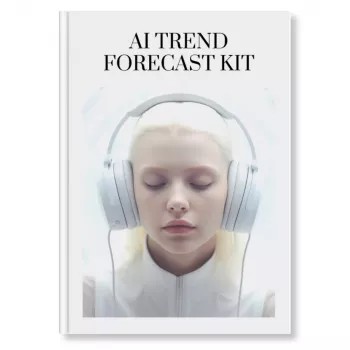
New ideas appear everywhere, but only a few turn into reliable opportunities. The difference is rarely “intuition” alone—it’s a repeatable routine that separates temporary noise from durable shifts. The AI Trend Forecast Kit is built as a digital, AI-assisted workflow—part checklist, part guide, part ready-to-use question sets—so entrepreneurs, marketers, and innovation teams can scan markets, validate signals, and convert insights into clear decisions on positioning, content, and product direction. For more guidance, see [PDF] AI TOOLS WITH DESCRIPTIONS – Tiffin University.
Instead of chasing headlines, the kit helps create an evidence-backed trend thesis you can explain, revisit, and improve over time—especially useful when markets change faster than quarterly planning cycles. For further reading, see Complete Book List (eBooks & Print Books) – Research Guides.
If your team debates what’s “real” every month, a lightweight scoring and validation loop is often the missing piece. For broader context on how emerging technologies mature over time, resources like Gartner’s Hype Cycle can be a helpful reference point when comparing novelty to adoption readiness.
Start with a real decision that has a deadline and a downside if you’re wrong: next quarter’s campaign theme, the next feature bet, a category expansion, or a new offer direction. Clear decisions create clear “success metrics” for your trend work.
Pull signals from at least a few lanes so you don’t get trapped in a single bubble: customers, competitors, creators, search behavior, funding, and regulation. For policy and regulatory signals specifically, the OECD AI Policy Observatory is a strong source for tracking developments that can reshape adoption.
Group related signals into 2–5 themes. For each theme, write a one-sentence hypothesis that makes a testable claim. Example format: “Because X is happening, Y audience will increasingly want Z outcome, and will choose providers who do this.”
Run small, fast experiments before committing: a landing page test, five customer interviews, a content pilot, or a small-budget ad. This is where many “great trends” get filtered out—and that’s a win.
Turn the strongest themes into specific outputs: messaging angles, roadmap items, partnership targets, content pillars, or a short list of test offers. If you want benchmarks on how organizations are operationalizing AI initiatives and measurement, McKinsey’s State of AI can provide useful framing for adoption patterns and priorities.
Scoring each theme consistently helps avoid overreacting to hype. Keep brief notes for every score so the decision stays explainable weeks later, and re-score monthly as evidence accumulates.
| Criterion | What to look for | Score (1–5) |
|---|---|---|
| Velocity | Mentions, adoption, or demand increasing across weeks/months | |
| Breadth | Appears in multiple communities or industries, not just one bubble | |
| Durability | Driven by structural forces (tech, demographics, regulation), not novelty | |
| Customer Pull | Clear pain points, willingness to pay, or strong engagement signals | |
| Feasibility | Fit with capabilities, time-to-market, and acceptable risk | |
| Competitive Heat | Crowded space vs. whitespace (lower heat can be higher opportunity) |
Yes. It’s structured as a guided checklist and workflow, so you can start with one decision, gather a small set of signals, and use the scorecard to keep the process simple and repeatable.
The question sets are tool-agnostic and work with most modern AI chat assistants. Paste the questions into your preferred platform and refine them to match your niche, audience, and constraints.
A practical cadence is a weekly light scan, a monthly re-score, and a quarterly synthesis. Faster-moving industries may benefit from tighter loops, while steadier categories can review less often.












Leave a comment